A talk made me angry last week.
I watched two online conferences, back to back. UXcon Vienna, then Hatch in Berlin. Three days of talks, from my desk. At Hatch, Kevin Cannon presented a Chrome extension that spots websites made with AI.
My first thought: another attack on the tool. We never start from a blank page. We start from a moodboard, a reference, the rough mock-up of a client who thinks they know what they want. Why would AI be the only illegitimate starting point?
Then I reread my notes. His extension doesn't hunt down AI. It flags pages that show “an AI tool's default look instead of their own aesthetic”. The default look. It isn't the tool he's pointing at. It's the setting nobody touched.
And I found that word everywhere. In talks that didn't connect with each other. About our tools, our strategies, our AI assistants. Two conferences, one shared blind spot.
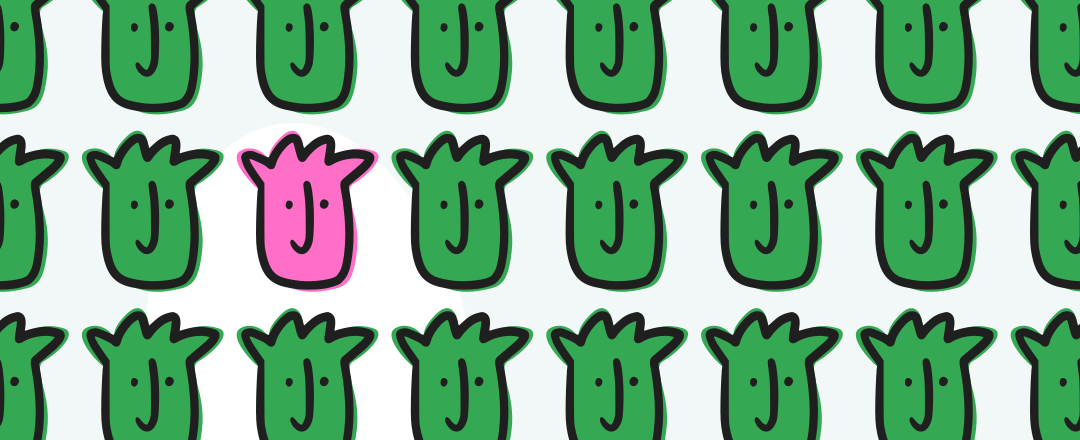
A default is a choice made before us, which applies until someone questions it.
The default setting is the design decision with the biggest consequences. And the quietest.

The default look
Cannon's talk had a title that lands: “Don't write like a robot. Don't design like one either.” His point is simple. Ask an AI for something without being specific. It fills in the gaps. With its own settings. The result is fine. Above all, it's average, in the exact sense: the most probable.
Hence his two rules, which I fully support:
Escape the average.
Be able to defend every design decision.
Kevin Cannon
Because that's where the default becomes visible. A choice you can't defend is often a choice you never made.
What we truly choose, by contrast, stands out at first glance. In Vienna, a brand designer showed it with motion: “Motion is totally part of the magic.” Movement, rhythm, the detail that makes you smile. No tool hands it to you by default. You have to go and find it.
I stop agreeing with Cannon in the second half of his talk, when he proposes spotting AI and labelling every post based on its origin.
A “Human” or “AI Detected” badge shows where content comes from. Not whether someone made a choice. A hollow text written by hand gets through. A text written with AI gets flagged.
So my texts would be flagged, because I use AI without apology but with intent. I treat what it gives me as a starting point to question, not an answer to deliver.
The problem was never the starting point. It's stopping there.
The default tool
But AI is just one tool among many. And we rarely choose our tools. At Hatch, Jonny Burch asked a question I had never put into words:
How did engineers get to choose?
Jonny Burch, Hatch
Developers choose their languages, their frameworks, their tools. They build them when they need to. We, for years, have been drawing in the same canvas, with the same layers panel, the same constraints. No wonder interfaces look alike.
The more you master a tool, the harder it becomes to switch. So you master it even more. The default doesn't just come from the software. It comes from habit.
His shift in thinking rests on two observations placed side by side. “We can code now.” And we're asked to go faster. For him, both lead to the same place: building our own tools.
That's what I do. I design and code my own apps, with AI as an accelerator. Not to change jobs. To stop inheriting the choices of software I didn't choose.
A tool you didn't choose ends up choosing for you.
The default strategy
What holds for our tools holds for our strategies too.
The default, here, is an entire continent copying Silicon Valley's playbook. Nicole Michaelis says she did it herself. Her team took on the roadmap of their biggest American competitor. And customers left in large numbers. They weren't asking for new features. They wanted the ones they had to work for their own needs.
Why doesn't the recipe work here? Because the context is completely different. On her slide, the United States: one language, one federal legal system. Europe: more than 24 official languages, 27 legal systems. Applying the same recipe means answering a three-dimensional problem in two dimensions.
But this fragmented Europe isn't a handicap. It's a design problem, so exactly our job. “Amsterdam can understand Warsaw. If the questions are built for Warsaw.”
The same goes for accessibility. With the European Accessibility Act, an American company selling certain products or services in Europe, from e-commerce to banking, must follow a European standard. Languages, rules, everyone's needs: what we saw as constraints becomes an advantage.
And what erases those needs, Nicole Michaelis summed up in one sentence, to pin above every dashboard:
‘Reduce churn’ is not a metric. It's an average hiding six different problems.
Nicole Michaelis
The default is always an average. And an average always leaves someone out.
And yet, breaking everything isn't the answer
Beware the opposite reflex. Rejecting every default is exhausting. And it's another way of not choosing.
Some defaults deserve to be kept. Randy Hunt points out that quality doesn't come from extra time, but from systems that make the right decision easy. A well-thought-out design system is exactly that: a setting chosen once, with care, that lets you move fast without cutting corners. “Speed is a tool, not a philosophy.”
Still, you have to tell a good default from a bad one. Kyle Alexander gave me the answer without meaning to. He showed the system prompt of an AI assistant built into the Square till: the instructions that govern all its behaviour. The assistant acts alone on anything easily undone. It asks permission for anything irreversible, anything touching money or affecting someone else. And it never gives itself more freedom without saying so.
I draw three questions from it, to ask of any default setting:
- Can you go back? A good default is undone without effort.
- Can you see it? A good default doesn't hide. It says what it does.
- Do you know who chose it, and why? A good default has an author and a reason.
I asked myself these without naming them while building Walou, my grocery management app. The app's central setting is consumption: you tell it once that you get through roughly so much a week, and everything else follows. This setting has a default value, and above all it has two authors. The app readjusts it on its own, by watching how often you buy the product again. And it shows it on screen: the value you set, and the date it corrected it. You always know which of the two is speaking.
My third question comes from there. A default setting with no visible author is a decision nobody owns. That nobody questions. A default doesn't always have a single author. But it should always have someone who is responsible for it.
Where I got it wrong was another setting. Changing a product's unit recalculated its stock without asking. The action was small. The consequence wasn't. And nothing showed it. A setting that silently changes another is no longer a setting.
Keeping a default can be a choice. So can breaking it. What matters is knowing which one you're making, and why.
So what now?
Defaults we put up with: the look the tool suggests, the tool everyone uses, the strategy we copy. And defaults we're right to keep, because someone truly chose them.
Each time, the job isn't to reject everything. It's to look at the setting, and decide.
And it's not just about designers. The teacher who sets the order of oral exams. The councillor who picks the language of a form. The school canteen that decides which dish is served when you haven't booked. They all set defaults. They all decide for those who won't say a word.
Next time you design something, look for the setting nobody touched. Ask yourself the three questions. Can you go back? Can you see it? Do you know who chose it? And add a fourth: for whom?
Who chose the default? I want the answer to be: someone. Someone who looked, hesitated, and decided.